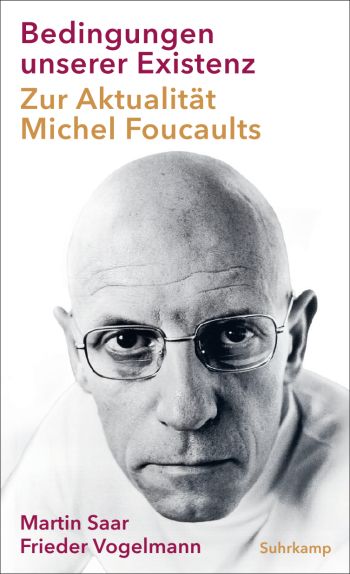
Bedingungen unserer Existenz. Zur Aktualität Michel Foucaults
Berlin: Suhrkamp, 2026. 2026How do we view Michel Foucault today? How might we assess the impact of his widely read and much-criticised work in our time? On the one hand, it ranks among the canonical sources of modern humanities, cultural studies and social sciences, which Foucault has shaped more profoundly than perhaps any other post-war author. On the other hand, in recurring debates he is held responsible for the irrational aberrations and relativist dead ends of contemporary thought.
In their astute philosophical exploration of Foucault’s legacy, Martin Saar and Frieder Vogelmann present neither an unassailable authority nor do they encounter a dissolution of truth, an absolutisation of identity or a fragmentation of politics. Rather, they discover a highly agile diagnostic mode of thought dedicated to the preconditions of what is deemed true, authentic or legitimate in each instance. Foucault’s famous distancing manoeuvres are primarily an expression of a style of thinking aimed at intervening in political and social reality. Foucault’s philosophical critique concerns nothing less than the conditions of our existence.
Reviews
Schweitzer, Tobias: Verflüssigung der Gegenwart, Philosophie Magazin, 8 September 2026.
Matthias Rothe: Wie es geworden ist. Texte und Schlappen: Neues zu Michel Foucaults 100. Geburtstag, Lesart. Journal für unabhängige Literatur 3/2026, S. 61.
Tania Martini: Was er sichtbar machte. Über die Aktualität von Michel Foucaults Denken zu seinem 100. Geburtstag, Frankfurter Allgemeine Zeitung, 2. Oktober 2026, Literaturbeilage S. 11.
Alexander Kluy: Bücher sollten Bomben sein. Zum hundertsten Geburtstag von Michel Foucault, Der Standard, 11. Oktober 2026.
Tobias Schwartz: Michel Foucault: “Der größte Denker unserer Zeit”, Berliner Morgenpost, 12. Oktober 2026.
Lothar Müller: Wie wir heute auf Foucault blicken, Süddeutsche Zeitung, 15. Oktober 2026.
Matthias Rothe: Es kann alles auch ganz anders sein, taz, 15. Oktober 2026.